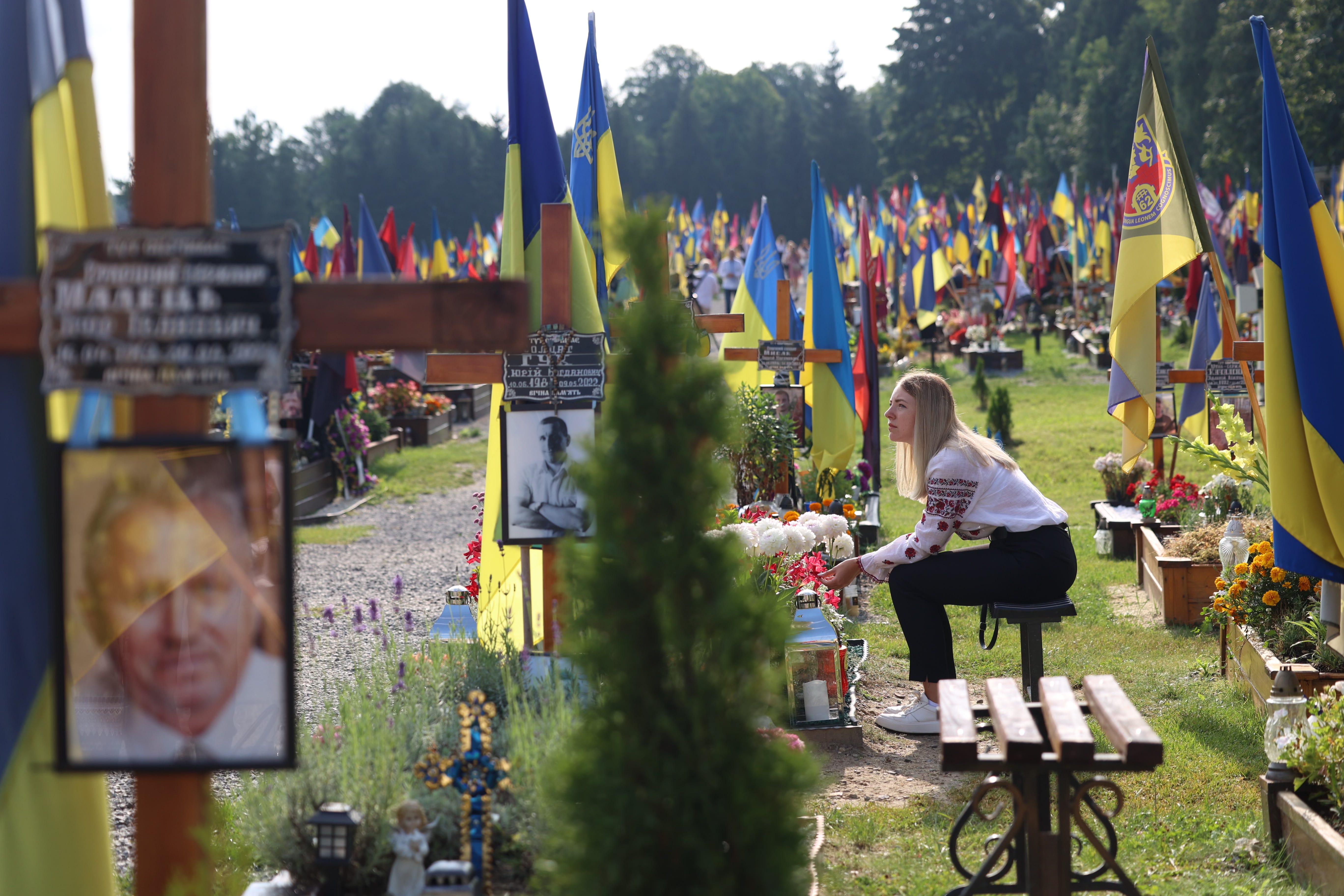
Myroslav still thinks about fixing the gazebo in his garden. Andriy, his son, always talked about coming to help him. “We can sit out in the garden and have a beer, Dad!”
Somehow, life always intervened. Andriy had one child. Then he had another. Then his country called. But Myroslav looks forward to sitting with his son and watching his grandkids playing on the grass.
The old man sighs as he spreads mulch over the soil. He has to prepare his garden for winter.
Viktoria groans as she reads her son’s homework — or, at least, what actually exists of his homework. She doesn’t have the words left to persuade him to try harder, and she doesn’t have the strength to intimidate him.
Some days, she can hardly force herself to go to work.
From his bedroom come the muffled sounds of explosions. “What would your dad think?” She is tempted to say. But she knows her husband — his father — is being reduced to a faceless source of fear and shame.
For a moment, she resents Maksim for not being there with her. But he might resent her for being so far away. Sometimes, life is too unjust for people to make sense of who to blame.
Volodymyr drinks a shot of vodka.
There is no one here to toast. So, he toasts old friends who cannot hear him.
Artem is dead (Bakhmut). Danylo is dead (cancer of the ass). Anatoly? Anatoly! Anatoly is alive, as far as he knows.
“To health!”
When did he last see Anatoly? Who knows. But Volodymyr remembers when he, Artem, Danylo and Anatoly went swimming in the old lake in winter. After, they had shivered with the thrill of lucky recklessness.
How good it would be to meet and talk about old times again? Volodymyr reflects that he couldn’t tell his friend anything about what he has been doing in recent years. The women. The bar fights. He can almost see Anatoly’s stony face in front of him.
“To life!”
Anastasia dips into the bookshop after buying groceries. She wants to read on the bus rather than browsing Instagram or the news.
But where do you start in a bookshop? In a supermarket, you have a good sense of what you want to eat. But how do you even know what you want to read?
Does she want something challenging? Funny? Sentimental? Scary? Erotic? Could she find a challenging, funny, sentimental, scary, erotic book? You can’t ask a shop assistant for something like that.
Anastasia sees the name “Camus” and remembers reading him at school. Perhaps he’ll make more sense now. But she doubts that he’ll be funny, sentimental, scary or erotic.
Still, The Stranger joins her packets of lentils and pasta. She pauses by the bridal shop on her way out into the evening cold.
Mariia is studying the blood on her knee. It trickles down her leg, with a kind of determination, but she smears it across her shin before it can reach her sock. She wouldn’t like to distress her mother with a bloody sock.
Mariia sighs, picks up her bike and climbs on again. Her dad had brought her the bike when he had been back on leave. She didn’t want to waste it. It had come from the war.
One day, if she could learn to ride a bike, she could learn to drive a car. She could learn to drive as well as her dad.
The wind picks up as Mariia starts to pedal. She takes deep, consistent breaths and looks at the path ahead of her. She stares at a tree in the distance, imagining that she can use her mind to somehow pull her towards it.
Now she’s riding. She passes houses — one, two, three. They might as well be miles. They might as well be sky.
Somewhere, a truck is veering into a tree. The shouts of its five startled occupants disappear amid the devastating storm of machine gun fire.
Redundant bullets keep piercing the truck — as if it is the lifeless body of an elephant. The machine gun fire seems almost celebratory — a predator’s howl.
Then the sounds of the guns slowly, menacingly fade — somewhere becoming unexpected phone calls from strangers.