

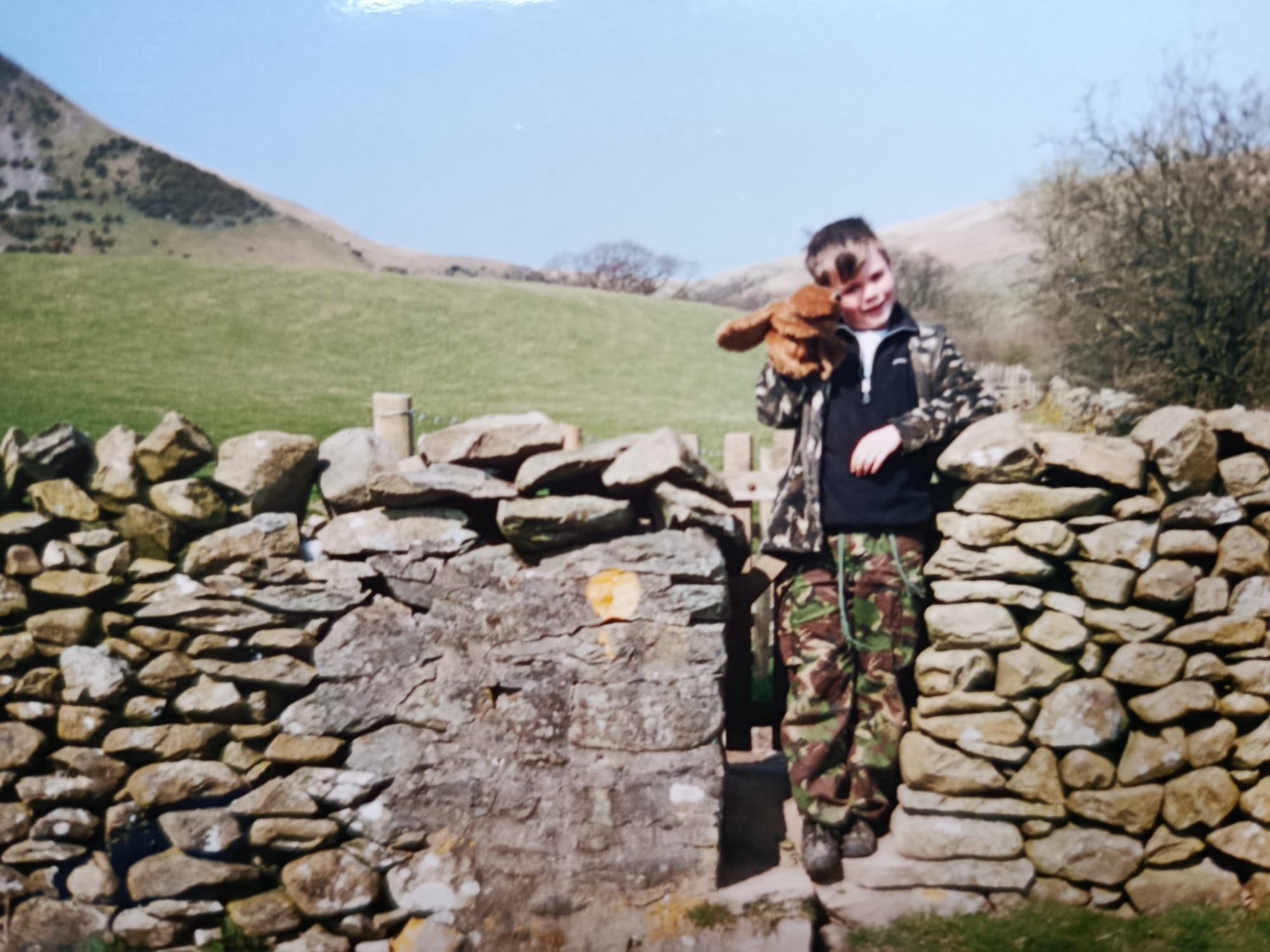
When I was a young kid, I was given an orange-brown glove puppet in the shape of a dog. I called him Eddie.
Eddie and I were inseparable. We really were inseparable. You couldn’t have ripped that glove puppet off my hand with pliers.
He soon had a voice — a slow, halting, gravelly voice. He developed an off-kilter way of commenting on human behaviour — seeing the world, as someone said of Peter Cook, from a slight angle. When my dad was singing “Wannabe” by the Spice Girls, for example — and don’t ask me why — Eddie would croak, “What do you want Dave?”
A whole society of soft toys emerged around him. There was Tommy — a daredevil who was frequently hurled out of the window. There was Keller — a by-the-numbers glove puppet portraying Lady from Lady and the Tramp, who developed a quasi-Caribbean accent in an attempt to make him “characteristic”.
But Eddie was the favourite. When he was my hand, he really became his own man — or, rather, his own dog. It wasn’t me nipping the noses of adults — it was Eddie. (Yes, I do appreciate how aggravating this could have been.)
He acquired imaginary enemies. The Granary Bread Monster was one of them — not just a “lol so random” creation — more forgivable though that would have been when I was six — but a reflection of just how joyless and repulsive I found granary bread. When I imagined something monstrous, it just made sense that it would be made of granary bread.
Eddie could even get bizarrely philosophical. Sometimes, my Eddie-less hand would become more Eddie-like in a sort of nascent juvenile commentary on substance dualism. (What was the real Eddie?)
The important thing was that I loved Eddie. Through Eddie, I could feel a lot more confident, and have a lot more fun, than I could as, well — myself.
Then I lost him. I lost him while visiting the library in a shopping mall in Bath called the Podium. Perhaps I’d put him down while I was reading a book, or perhaps he had just fallen out of my pocket. We looked about for a long time — and what must have felt to my parents like a very long time — but he had disappeared.
I remember just how strange it was to think about the fact that he really wasn’t coming back. It wasn’t some kind of joke. My parents couldn’t click their fingers and conjure him up. In a very real sense, that was when I first internalised the significance of death.
My mum — angel that she was — soon created a new Eddie. Again, this raised interesting philosophical dilemmas. Was Eddie a spiritual phenomenon that could be transferred between glove puppets? Or was there something essential to Eddie about that original glove puppet? I don’t want to take a position on the mind-body problem. All I’ll say is that Eddie was never quite the same. If nothing else, he had belonged to a more innocent world.
Believe me, I appreciate that when you read all this, it won’t sound nearly as entertaining as it felt at the time. But childhood memories — even when they are your memories — never have the same mysterious richness as childhood experiences. It’s not just a matter of forgetting things. It’s a matter of looking at the world through a more rationalistic lens.
That’s life. Childlike wonder inevitably meets worldly realities and mature responsibilities. But to accept this — as we should — is not to deny the essential nature of an enduring enthusiasm. Without that enthusiasm, after all, what is the point?
If I’m ever feeling jaded, bitter, humourless or otherwise overearnest, I should feel four of my fingers joining in a horizontal line above my chin-like thumb, and the hand swivelling around with a faintly canine look of pleasant curiosity.
“What do you want, Ben?”
I had imaginary sisters when I was young.
I had actual sisters too, aged 15 and 12 when I was born. The imaginary sisters were nicer to me than the real ones. (At least one of the real ones, anyway).
Magical! I feel honoured to have met Eddie.