

I somehow didn’t read Patrick Radden Keefe’s smash hit New Yorker article about the mysterious death of Zac Brettler, so I came to his new smash hit book London Falling without really knowing what to expect.
It might be tedious to praise a book that has been doing so well but it would be dishonest not to. London Falling is beautifully written and makes for compulsive reading. I started it as soon as I had sat down in London Stansted Airport and finished it as I walked out of Katowice International Airport.
Zac Brettler was a 19-year-old Londoner from a rich — but, crucially, not that rich — family of British Jews. At his private school, he was surrounded by the children of Russian oligarchs, and he developed an attraction to conspicuous wealth. He began to hang around with shady businessmen — and to be involved in shady business deals. Then he disappeared.
Zac’s body was found on the banks of the Thames. It turned out that he had leapt off the fifth-floor balcony of a luxury apartment block, with CCTV capturing his final moments. The apartment was occupied by a gangster known as Indian Dave, who Zac had encountered through the slippery son of a controversial British Indian multi-millionaire. Zac had jumped, that was clear. But what had made him want to jump — or feel like he had to jump?
That question is never answered — at least definitively. True crime obsessives might find this disappointing — but this is often the truth of crime. What we know is the bizarre fact that Zac Brettler had been posing as the son of a deceased Russian oligarch. The gangster and his British-Indian business acquaintance had thought that the naive young teenager could be a path to easy riches.
Radden Keefe tells a gripping tale, but he never forgets that he is writing about real people who experienced a dreadful tragedy. The reader can’t forget it either. In one poignant detail, for example, just before Zac’s disappearance, his mother, who invested so much of herself in her family, snatches a moment of private personal pleasure as she has her photo taken against an illuminated pair of angel wings on Regent Street. “It was the last time for a long time that she would feel happy.”
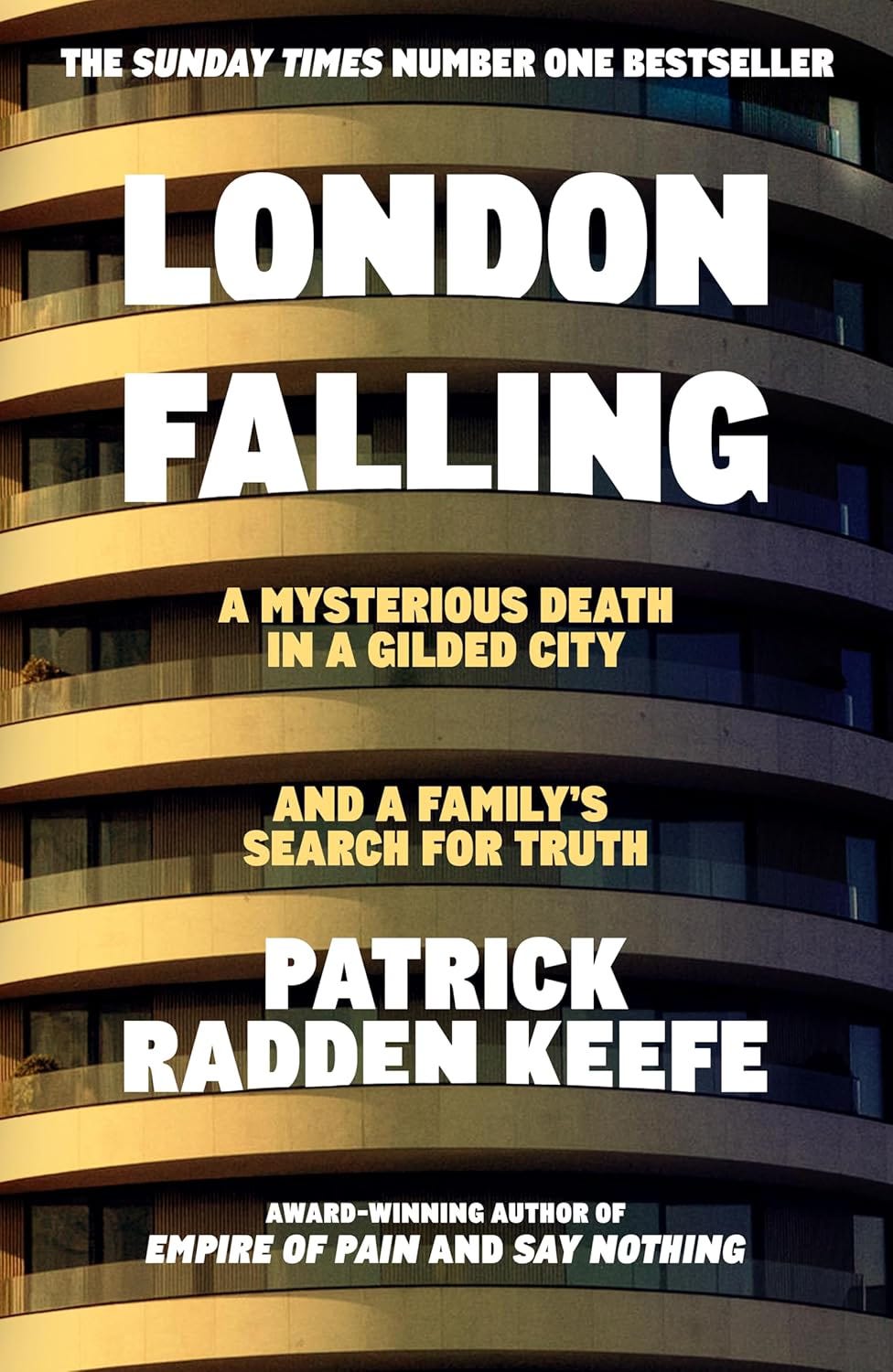
On one level, London Falling is about a city built on artifice — wealth built on debt, careers built on bullshit, and prosperous and bustling streets built on dead bodies. On the back cover, the author Nick Hornby calls it an “unsettling book about my city — a city, it turns out, I don’t know at all”. I’m not sure the book is quite as revelatory a portrayal of London’s underside as some reviewers have thought. There is a lot of interesting stuff about the darkest elements of business and geopolitics, for sure. But as Radden Keefe himself writes in the book, we are past the heyday of dubious foreign wealth in London (much of which has emigrated to the Middle East). Indian Dave — who killed himself a year after Zac’s death — is an alarming figure, certainly, but conspiratorial rumblings in the book about his power and influence are somewhat undermined by the fact that he was dim enough to take it as an article of faith that a random teenager was the uber-rich son of a Russian oligarch.
As a book about alienation and self-invention, though, London Falling is a masterpiece. It very much succeeds in reflecting on the rootlessness of London, where people frantically attempt to define themselves in a stew of trends and archetypes. The bizarre trio of the middle-class British Jewish kid pretending to be a Russian multi-millionaire, the smooth-talking son of British Indian wealth acting like a successful businessman, and the gangster whose feared reputation is shaking amid old age and paranoia, make for a powerful perspective on dislocation and insecurity amid what Zygmunt Bauman called “liquid modernity”. True, “fake it till you make it” can be the formula for success stories, even if “fakin’ till it breaks him” can be the formula for horrors. But this is a striking book on the excesses of self-invention, especially when it starts from scratch. There are certainly multicultural questions here, though Radden Keefe is also right to point to economic abstraction and social media.
At the heart of the book is also a story about family — about how much parents can influence or even know their children. I must admit to feeling slight frustration as I read about Zac’s parents’ tolerance of their son’s descent into delusion. But then I remembered my own parents’ patient, hands-off approach to my eating disorder — and how much I suspect I would never have recovered if I had been compelled to try. Sometimes, the space between success and failure is luck. I don’t think any reader could fail to admire Matthew and Rachelle Brettler’s dedication to uncovering the truth about their son’s death — especially in the face of a police investigation that was at best incompetent and under-resourced. They do at least appear to have been fortunate to meet Mr Radden Keefe, though they were allegedly quite unfortunate to meet another well-known journalist who, it’s claimed, wanted money in exchange for covering the story, and then posted a photo of Zac’s corpse online.
One can’t help leaving the book thinking about the lies, horrors, and tragedies that nestle beneath the surface of our communities. When Zac met his businessman friend, he used to walk the latter’s dog. “Zac seemed to carry himself with a sense of pride,” writes Radden Keefe, “Strolling around Mayfair with this big, elegant, obviously expensive dog.” The dog was apparently present on the evening of Zac’s death. Somehow, I stumbled across a photo of the dog from the year after Zac died, on a page for “Street Dog Photography”. It is grinning for the camera, never thinking — as it, unlike a human being, could not be expected to think — about the young man with whom it used to walk.