

Fifty years ago, one of the darkest crimes in Polish history took place at Christmas. Three people were killed in front of dozens of witnesses, who were sworn to secrecy by the murderers.
In 1976, Jan Sojda was the richest farmer in the village of Zrębin. Unlike most people, he owned a tractor and a telephone. He was powerful enough that he was sometimes called “King Jaś” or “the King of Zrębin”.
Sojda was a cruel king — a man people either feared or relied upon. (It meant a lot, it seems, to be able to borrow his tractor.) He had carried a grudge against the rival Kalita family since one of their relatives had played a role in his 1948 rape conviction.
The man’s 10-year-old son would be shot on Sojda’s farm a few years afterwards, in what was determined to be an accident. But what sparked a hideous outburst of violence was something less sensational. In 1976, 18-year-old Krystyna Kalita was getting married. Sojda’s sister was helping to prepare the food, and was accused of stealing cold meats and tableware. This infuriated Sojda. He would, he declared, wipe out the Kalita family.
The anthropologist Ruth Benedict famously explored how societies can have a “guilt culture”, where norms are built around the individual conscience, or a “shame culture”, built around social perception. Obviously, all societies contain both to some extent. But Poland in the 1970s was more of a shame culture, and Sojda, detectives would argue later, could not tolerate this stain on his familial honour. Perhaps he also wanted to be seen as being above the law. The jurisdiction of the Polish state would not contain the King of Zrębin.
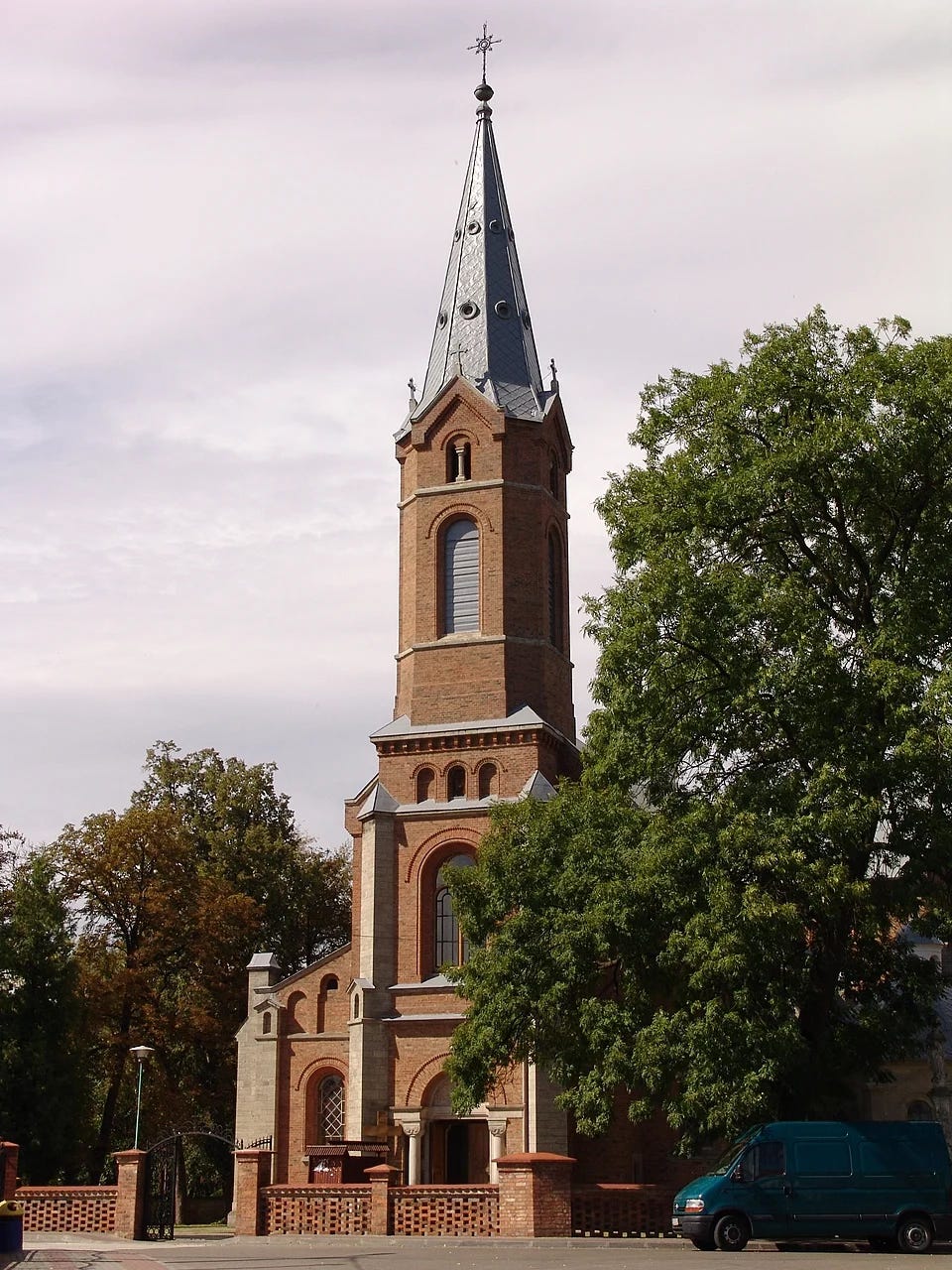
In Poland, the biggest Christmas celebrations take place on Christmas Eve. Afterwards, many Poles attend Midnight Mass. On December 24, 1976, various buses and cars took villagers from Zrębin to a church in nearby Połaniec. Some of the Zrębin residents went inside the church. Others, like Sojda, stayed on the bus. There was vodka on the bus.

Soon, occupants of the bus were thoroughly drunk. It must have been freezing, with bitter alcohol and hot tempers keeping people warm.
There, prosecutors later alleged, a murderous plan came together.
Somebody was tasked with going into the church to tell young Krystyna Kalita, who was heavily pregnant, that she had to go home because her parents had been arguing. She asked to take the bus but Sojda refused. So, she set off home on foot, with her husband and her 12-year-old brother.
Soon, a bus and a car were driven in pursuit of the unsuspecting trio. The car struck the young Mieczysław Kalita. Sojda and his sister’s husband, Józef Adaś, leapt out with a wrench. There were dozens of witnesses as Krystyna and her husband Stanisław were beaten to death. Mieczysław was then killed by being run over.
It was determined that the perpetrators would claim that a bus had been stolen and the victims had been killed in a road accident. Meanwhile, in a ritual of almost unbelievably audacious malice, Jan Sojda forced the witnesses to swear on a cross or rosary not to tell anyone. They also allegedly had their fingers pricked with a safety pin so they could mark a piece of paper with their own blood. More believably, Sojda is also alleged to have paid people thousands of zlotys in bribes.
Initially, the police believed that the trio had indeed died accidentally. The “King of Zrębin” even ended up carrying the coffins of the victims at their funeral. But one villager did not stay silent. A 13-year-old friend of the murdered Mieczysław was heard shouting outside the Sojda family home that its patriarch was a killer.
Pressure was applied to the boy’s family. His father later committed suicide. A witness who had spoken out against Sojda, meanwhile, disappeared and was found face-down in a few inches of water. His death was ruled to be accidental — like that of the 10-year-old who had been found shot to death on Sojda’s farm.
Sojda and several of his family members were put on trial, where they stubbornly refused to cooperate. Sojda sent notes from prison explaining who should be bribed and who should be intimidated. The suspects were found guilty, and Sojda and Józef Adaś were executed.
Sojda’s family, and the suspects who were imprisoned, maintained their innocence. Their lawyer Zbigniew Dyka, who later became Minister of Justice, also insisted that his clients had been wrongly convicted. But his 1993 attempt to have the verdict overturned was dismissed.
Certainly, it is hard to comprehend the existence of such a psychopathic and elaborate crime. Certainly, too, the communist-era police were less than wholly reliable. But Sojda’s advocates never explained how an “accident” narrative made sense. (Krystyna Kalita, for example, had been found partially stripped.)
There was no happy ending in Zrębin. The young man who had accused Sojda of murdering the trio, and whose family had been threatened and alienated, grew up to be an anxious drinker. The matriarch of the Kalita family, meanwhile, who had lost her son, her daughter and her son-in-law, kept living in the village among people who might have witnessed her children’s deaths, or who might blame her for the alleged injustice of their relatives’ executions or imprisonment. Zdzisława Kalita was ostracised by her neighbours. “You give it a rest,” she was told, “No one will return your children, and the living will be put in prison.” When the roof of her house burned, some muttered that it was God’s work.
“She lived there for decades to come until her death in 2020,” writes Karolina Grabińska:
Every day she went out for bread on the same rural road. She passed by the houses of 18 neighbors who had served several years for making false testimony and returned to their farms.
Rural village life is easy to idealise — for the community spirit, for the closeness to nature, and for the sense of life existing at some distance from mass society. Such charms can be real, certainly. But all ways of life have their bones in the soil as well as their flowers above the ground. Tight-knit communities are vulnerable to domination by despotic personalities, and to cruel and dishonest behaviour in the name of securing collective norms.
Zrębin is quiet today. The houses are nicer but the silence has endured. Granted, I can sympathise with some of the villagers. At times, to be in Zrębin must have felt like being in the eye of a media storm. Books have been written. Films have been made. A serial has just been released. For the outside world — and this author is implicated in this — Zrębin is a site of morbid spectacle. For the villagers, it’s still their home.
Some old pensioners, meanwhile, have continued to deny the murder and collusion. “I don't know anything about finger piercing or taking oaths,” one alleged witness told a journalist.
Well, who knows? Perhaps he doesn’t. On the other hand, this is exactly what someone who had taken an oath would say.