

Sometimes, remembering someone is a conscious act. It means dwelling on them — like visiting a museum in your mind. Sometimes, it is random, like when I’m walking down a hill and am struck by the memory of Mum’s hysterical laughter when we were descending a Scottish mountain and Dad was pondering whether our church should have a group called Christian Relationships And Prayer. (Acronyms were big back then.)
Sometimes, it might not be conscious at all.
Two years after my mother’s death, I wrote a piece called “Remembering Mum”. What’s sad, on the fifth anniversary of her death, is how much I don’t remember. Her voice, for example, is fading in my memory. I can just about hear it, like a murmur from another room, but not at all as clearly as I would like.
I can see her, of course, but I have to look up photos to appreciate the full vividness of her face — something I should be grateful for, because it is a privilege most people throughout history never would have had as the memories of their loved ones slipped through their fingers.
On the other hand, I find myself realising how much I didn’t know about Mum when she was alive. Even looking at her face, I see things I never did — the way a smile could be tinged with sadness, as if it had been hard won, like when the struggle stays on a runner’s face after they cross the finish line.
Why was she in such pain when she didn’t tell a random stranger about Jesus? Why did she want to go to North Korea? What made her love flying, and hate driving, and suspect that Arcade Fire might have been Satanic?
To me, that was Mum. And to some extent she simply was herself. (Inasmuch as anyone is simply anything.) Human beings aren’t like detective stories, with neat answers at the end. But I regret not asking more questions when I had the chance.
I think about what Mum has been missing since her death. I wonder what she would have made of my engagement, for example, or of my work. I even wonder what she would have made of global phenomena like the Russo-Ukrainian War.
Of course, there is an irrational aspect to wondering how a changing world would have seemed to someone who is frozen in the past. How would Mum have changed if she was alive? Would the fighting in Ukraine have troubled her pacifism? Would the emergence of various scandals related to abuse and infidelity — which have struck several people who inspired her — have shaken her attachment to the church? (Sometimes, though I feel bad for saying this, it’s less sad to know that Mum is missing out on something than it is at others.)
When Mum was at Cambridge, she encountered a man named Chris who inspired her as a young evangelical Christian. He was the sort of passionate evangelical who would interrupt lectures to preach the gospel. Mum was always disappointed in herself for not being so radical. At some point, we looked up Chris and what might have become of him. We found some archived newspaper clippings from the 1980s, which reported that he had disappeared from his “Saffron Walden evangelical Christian group”, amid fears that he might have been “kidnapped by people who oppose his way of life”. Another report speculated that he might have been a victim of Dennis Nilsen. Actually, he turned out to have been teaching music in France. What might Mum have made of this peculiar tale?
Perhaps it would have affected how she saw the world. But perhaps it wouldn’t have made a dent. It is not as if she spent the best part of six decades on Earth without facing an apparent contradiction. Again, we can’t pretend to know what people we have lost would think of events they never had the chance to see or learn about. It presumes not just that we knew them better than we did, but that we know what they would have become.
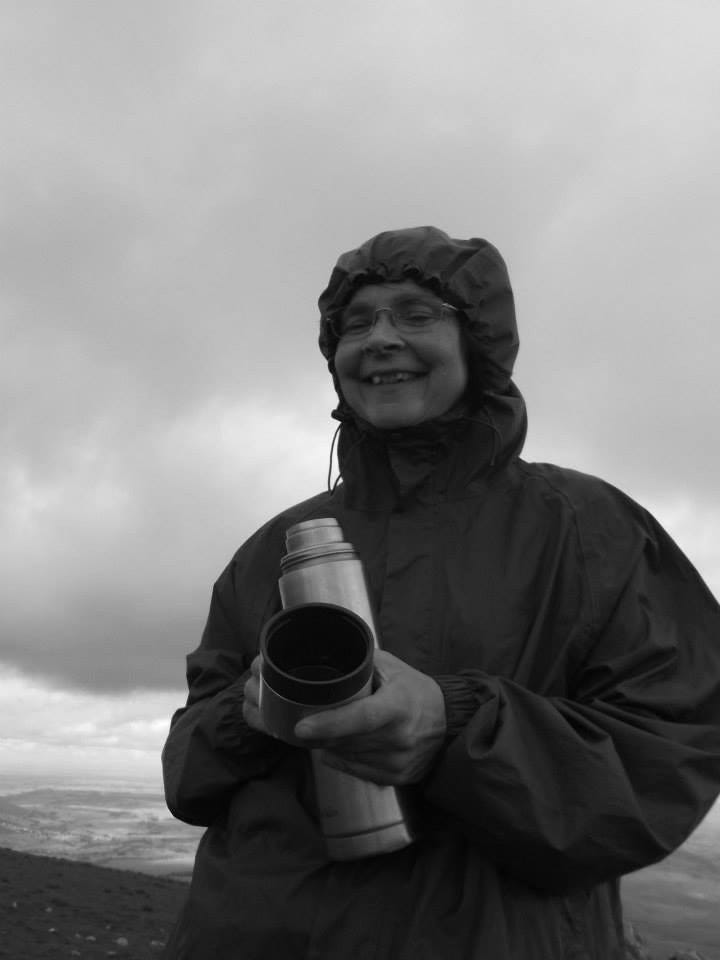
Still, that doesn’t mean that someone’s legacy is passive. It’s heartening to think that mum has lived on. She has lived on through her family. She has lived on through the people who were touched by her countless acts of kindness. She has lived on through the students she taught, and the charities she backed, and the institutions she achingly supported. She has even lived on — as I know from some kind messages I have received — through the little book of poems that I had posthumously published. (You can get it almost for free.)
I love You on the hillside
struggling up scree
tugging on heather
scrambling on rocks
…just a little steeper
…just a little nearer the edge
where sky and mountain meet
Mum could be frustrated that she was not making a big enough difference in the world. She thought about moving to live among the poor — and, indeed, about travelling to North Korea. But the difference that she made in the world was dispersed, and no less beautiful for that — like sunbeams falling through the spaces between trees. I hope that there was part of her that understood this.
I cannot focus on the difference she made on me without acknowledging that this was just a small part of her influence on the world. Still, I am me, so of course I’m going to dwell on it. I think we often found each other vaguely mysterious. When I was filled with the arrogance of youth, this could be frustrating, on both sides, and obnoxious, from my side. Once I had reached the less febrile arrogance of adulthood, we reached a deep and affectionate understanding.
Everything from our politics to our favourite pop culture could be wildly different. But I think we started from a similar place: from a hunger for the truth (even if I often look for it in the wrong restaurants) and for a desire to transcend the everyday and to find transcendence in the everyday. I hope I also have some of her kindness (though this would be a bit like claiming that my knowledge of five chords on the guitar means that I have some of Jimi Hendrix’s musical skills).
It is sad to think that I will lose more memories of Mum. I’m so glad, at least, that she was a writer and that if I have children of my own they will, in a sense, be able to meet her — and every time I try to put the truth before my own convenience, or try to reach out a hand to someone who needs it, there is a sense in which I’ll be remembering her.
Sometimes, when we were out for a family walk, Mum would be so full of energy that she would run into the distance, and then back and around us again. She ran into the distance, in 2021, but her spirit is still running back to us again and again.
I miss her - there's an African greeting: "I See You." - She always "Saw" me . . .
Lovely, Ben.