

To Kraków for the weekend — Poland’s cultural capital and something like Mecca for British stag do-goers. For me, a weekend trip is largely an excuse to drink beer somewhere scenic. Luckily, my wife had bigger plans for the weekend, so we headed to museums as well as bars.
I’d wanted to treat the weekend as something of a chance to recharge my creative batteries. I have been more successful in writing than I ever thought I would be. I’m extremely grateful. But it’s interesting that the incentives of a lot of modern writing can actually encourage us to be less creative.
In opinion commentary, for example, we’re incentivised to react quickly and impulsively, and often to the most ephemeral of current events. Again, I’m truly blessed to be doing what I do. But I sometimes have to really force myself to be more reflective or experimental.
It was inspiring, then, to visit Muzeum Stanisława Wyspiańskiego.
Stanisław Wyspiański was an intimidatingly creative man. Nowadays, we have people who call themselves “creatives” because they made an advert for a tech company. Wyspiański, who lived between 1869 and 1907, created paintings, plays, poems, designs for stained glass windows, designs for architecture, designs for furniture, and designs for books. (Bear in mind that he died when he was 38.)
He must have had immense creative ambition. While he had studied painting — under Jan Matejko, whose Stańczyk is a favourite of mine — he took up playwriting having fallen in love with the theatre while designing furniture for the stage.
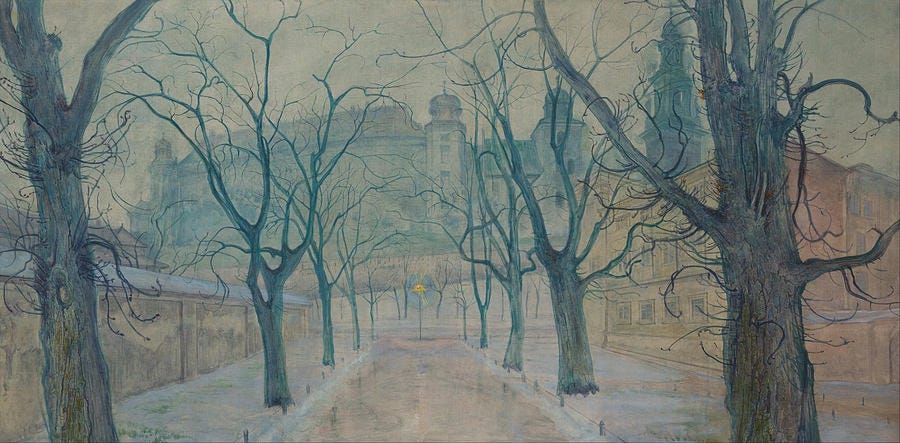
Of course, the quality of what you create tends to be more important than the fact of creating something. I am very ignorant when it comes to the visual arts, so I cannot claim to offer more than amateurish enthusiasm when it comes to Wyspiański’s paintings, but I love the interplay of natural resonance and human resonance in works like Early Morning near the Wawel Castle (Planty Park at Dawn).
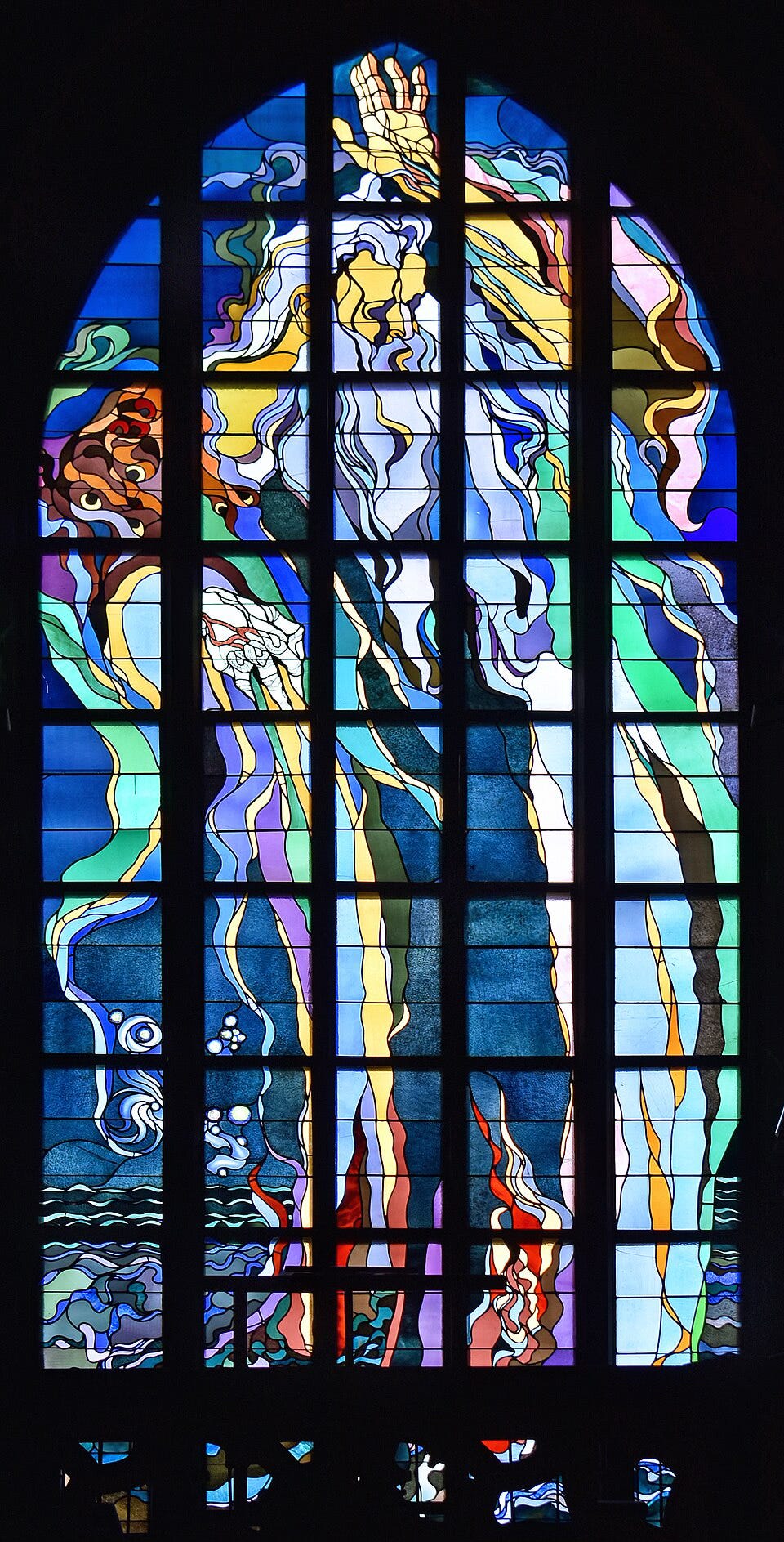
In Wyspiański’s stained glass window designs, meanwhile, God is depicted in ways that seem — to this, again, poorly educated observer — strikingly and powerfully original. My wife observed that the monumental God in God the Father, which can be seen in St. Francis of Assisi Church, bears a resemblance to depictions of Poseidon.

But I want to focus on a far less grand — but no less compelling — work of Wyspiański’s here — a rough self-portrait that he sketched a month before his death.
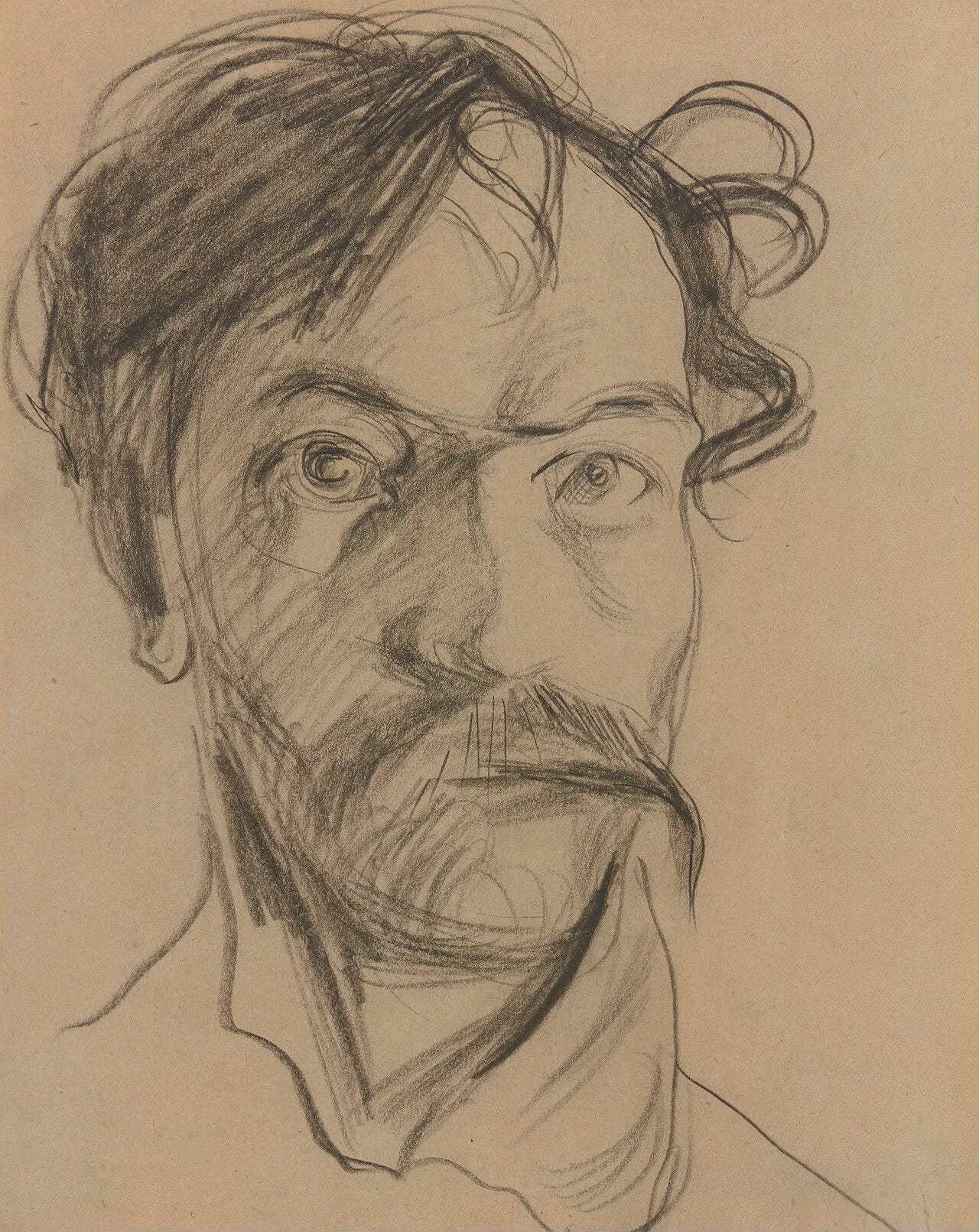
It was very obvious that Wyspiański was dying. His body was ravaged by syphilis. The artist Władysław Reymont is reported to have said:
He looked terrible … with a sunken, blackened, and withered face; his right arm was bandaged, and he had only partial use of his left. His voice was strange and indistinct, yet his eyes remained the same: bright blue, commanding, and wise — eyes full of lightning and unyielding will.
I can’t resist quoting this, despite failing to confirm its validity, because the words are so clearly reflected in the sketch. Wyspiański, with his diminished hands, portrayed his own physical decline with clear-eyed objectivity. The once-handsome artist looks emaciated and sad. But his eyes are filled with fire — a vivid, almost maniacal conviction.
In his final weeks, Wyspiański remained furiously creative. He drew until he couldn’t draw. He wrote until he couldn’t write. Then he dictated. Creating, even as he died, was a means of maximising life and defying death.
Of course, there aren’t a lot of Wyspiańskis. Exceptional talent is, well, exceptional. Almost no one — and this author does not claim to be a reason to say “almost” — could be so creative even given unlimited time and resources. Nor would most of us create anything so good.
But to be creative is essential to human beings, if not to every human being then to humans as a species. It manifests our desire to understand reality, to explore its potential, and to express how we perceive the universe and ourselves. This relates not just to the results of creativity but to creativity as a process — as a means of understanding, exploration and expression and not just as a means of producing things. This — among other things — is what AI enthusiasts often seem to misunderstand.
In his poem “Let No One Weep Over My Grave”, Wyspiański wrote:
Someday maybe, someday yet,
when I tire of lying,
I’ll burst this house where I dwell
and start running toward the sun.
In a sense, Wyspiański really did this. His art has lived on for more than a hundred years after his death. Most of us won’t be able to say this — at least not in the sense that people will read us, or look at our art, or watch our films, or listen to our music for long after we die. (If they do at all.)
But we can try to add some sharpness or richness to the world — and perhaps it will look a little more sharp and rich once we are in our graves.