

What separates stand-up comedians from evangelical preachers? One group is made up of self-righteous narcissists with a God complex and the other is made up of evangelical Christians.
I’m joking, of course. But after hearing about Mike Warnke on an episode of “Why Are You Laughing” from Blind Mike Geary, I’m hooked. Warnke was an evangelical Christian comedian. He made millions of dollars selling comedy albums for lovers of Christ.
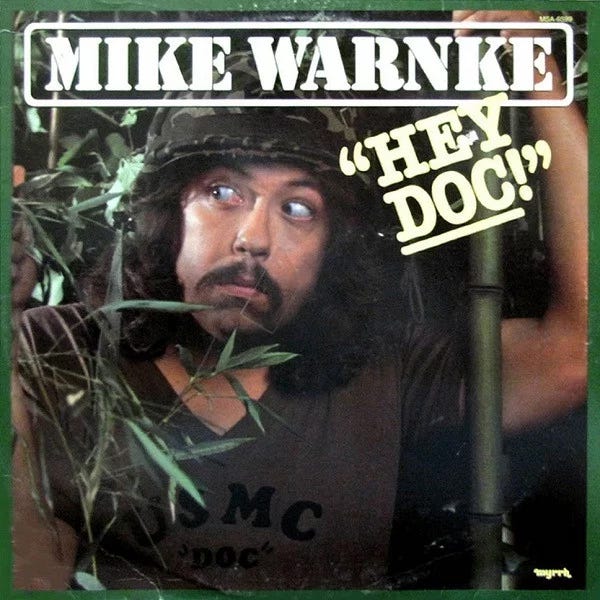
Frankly, at his height Warnke was … not as bad as this sounds. “Hey Doc” (1978) contains a funny joke about an atheistic soldier who goes to Vietnam and starts wearing a cross, the Star of David, the Star and Crescent and a pendant from the Native Americans because he “can’t afford to make anyone mad”.
Look, it’s hardly Norm Macdonald. But it’s not Brendan Schaub.
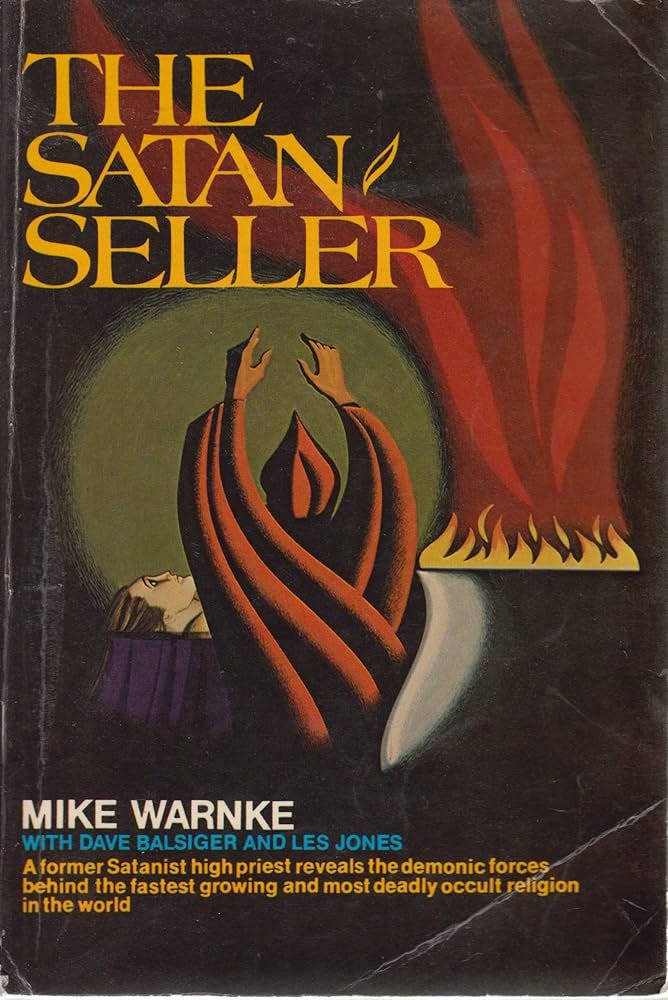
Yet this scratches the surface of how weird Warnke was. He didn’t rise to fame because of his jokes. He rose to fame because of a book he wrote called The Satan Seller.
Warnke was nothing if not a storyteller. The Satan Seller, which was published in 1972, starts with some evocative pages. As a young orphan, Warnke was sent to California:
To keep from seeing the inner emptiness, most Californians keep moving. A network of freeways has sprung up, enabling them to drink in the beauty at sixty-five miles per hour. Don’t stop — you might start thinking.
The young Warnke was a troubled child. He started doing drugs — progressing rapidly from marijuana, to LSD, to amphetamines. He also started selling drugs.
This was all under the influence of a mysterious friend named “Dean”. At a certain point, Dean realised that Warnke was falling apart. He introduced him to sex — “soft pink sex” as Warnke bizarrely calls it. Now, I don’t know a lot about ruined drug addicts but I don’t think they tend to be horndogs. For Dean, though, the orgies — “They were not just involved in conventional lovemaking” — were just the appetiser. He was actually introducing Warnke to Occultism.
“This witchcraft thing was big,” Warnke writes, “A whole lot bigger than even the most sensational journalism imagined.” This is not a line that should have inspired trust. This deal is so good that even a convicted fraudster wouldn’t offer it!
Warnke rose through the ranks of his Satanic cult — quite the achievement for a teenage junkie. Soon, he dedicated his soul to the Devil. There are a lot of naked women, goat skulls, and pentagrams on the following pages. There is also, in a pioneering detail, what appears to be a trans person (“This Charlotte … She used to be a brother”). “Maybe some day we’ll see who ends up on top,” muses Warnke.
I’m sure you can see where I’m going with this, but one of the more entertaining features of The Satan Seller is how even as Warnke’s gaining power in the Satanic world, he still seems like a total bumpkin. Moving into new occult headquarters, he is pleased to find books on the occult. “Now I would not be hampered by having to run back and forth to the library.” Don’t you hate it when you have to interrupt a Black Mass to pop to the library?
Obviously, it would be implausible if alleged Satanists were talking like Bela Lugosi. Still, it’s also odd how Warnke’s Satanists sound like good ol’ boys. “‘Say, Mike,” Paul said, ‘Will you give me a hand with this altar?’ ‘Sure, Paul. Be right there.” Gee, Mike, maybe then we’ll crack open a finger and have ourselves a cool glass of blood.
Soon, having organised enough Satanic rituals “without a hitch”, Warnke is invited to participate in some sort of occult convention (in Salem of all places). He is very light on the details of what the occultists actually believed. “I dug all the speeches,” he raves, “There was some talk of philosophy, of the might-makes-right variety.” Heady stuff! Warnke also hears about an “Illuminati” which is running the world under the command of Satan. This is just the kind of secret that I’m sure that young men who were flipping burgers and doing speed just weeks earlier get exposed to.
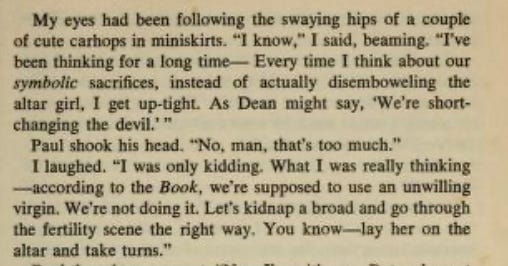
Warnke and his good time buddies had been killing cats and cutting off fingers, much to their mutual enjoyment. “I could not wait to get to the finger chopping,” Warnke writes of one meeting. Who could wait to get to the finger chopping? But it seems that Satanism, like hard drugs, leaves its users craving a bigger fix. So, Warnke orders his pals to kidnap and rape a girl. This they do, though Warnke himself is “too doped up to try anything … But I would get my kicks, watching”.
Warnke ends up being kicked out of the Satanic cult after overdosing on heroin, which seems a bit cruel of his occult brethren. Soon, he sees — of all people! — the woman he had had his friends kidnap. She forgives him in the name of Jesus Christ. A broken Warnke is soon exploring Christianity, joining the Navy, and being shipped off to Vietnam.
The story isn’t done. In ‘Nam, Warnke obeys an order to extrajudicially execute an alleged spy. His heart isn’t in evildoing now, though, and back in the USA he gets baptised. The book ends with a lot of ponderous musings about the evils of occultism in the USA.
The Satan Seller sold hundreds of thousands of copies. Somehow, Christians up and down the USA never thought to ask questions like “where is the evidence for this Satanic cult” or “if you’re admitting to all this, why aren’t you in prison”. Along with the similar memoir of John Todd, Warnke helped fuel the “Satanic panic” in the USA (Todd claimed to have been a “Grand Druid high priest in the Illuminati” before being convicted of rape and petitioning the government to return his collection of knives and women’s underwear).
It’s interesting to me that instead of becoming a more straightforward fire-and-brimstone evangelist, Warnke became a comedian. Both pastors and comedians can neglect their essential purpose — preaching God’s word in the former case and being funny in the latter — in promoting a certain image of themselves. What makes Warnke so bizarre as a performer is that he comes across as such a goofy, aw shucks sort of character yet his act is built around his being a reformed Satanic cult leader.
Yet he was extraordinarily successful. At one point, he was known as “America’s Number One Christian Comedian”. The governor of Tennessee apparently declared June 29, 1988 to be “Mike Warnke Day”. It was not until 1992, two decades after the publication of The Satan Seller, that the Christian magazine Cornerstone unveiled an epic exposé which cast doubt on pretty much everything that Warnke had ever said and done.
“Selling Satan: The Tragic History of Michael Warnke” is a devastating work of journalism. The events in The Satan Seller — the drug use and Satanism at least — would have had to take place within a preposterously short time frame. None of Warnke’s old friends and acquaintances could support his narrative. “I always wanted to write him a letter,” said one of his college friends, “And say, ‘Mike, when were you able to have this coven of fifteen hundred people?’ About the most exciting thing we used to do was play croquet.”
Cornerstone’s journalists also dug into Warnke’s private life. He might have been a bit of a square in his college days but his life as a famous evangelical was marked by divorce, infidelity and accusations of abuse and profiteering. According to “Selling Satan”, Warnke kept up a steady stream of fantasies. When he got divorced from his second wife, he allegedly told a friend that she had been murdered by the mafia.
For his part, Warnke admitted to “embellishment and exaggeration” but maintained that much of his story had been true. Perhaps he had once dabbled in the occult. Even Cornerstone acknowledged that “Ouija board type stuff” had been popular in campus. But there is a formidable leap between dabbling in the occult and leading a coven of hundreds of blood drinking Satanic rapists.
Obviously, the eccentric tale of Mike Warnke is an illustration of how much people are prepared to swallow if it suits their preconceptions. Nothing about the guy made any sense — unless, that is, you were hungry to believe in Satanic conspiracies and the redemptive power of Christ. Many of us dislike the way new atheists portrayed the faithful as mindless sheep — and rightly so! — but the scale of natural gullibility among human beings should still be acknowledged.
I’ll never be the first to warn of a “moral panic”. The fact is that elite corruption exists, and that it is almost impossible to talk about it without some form of irrational overcorrection. In other words, there can be a “moral panic” and real cause for concern. Still, the wilder claims about Jeffrey Epstein and his contacts, to choose a contemporary example, should inspire us to separate evidence from rumour and fantasy.
I’m also just interested in Warnke as a performer. When actors perform, we recognise that they are performing as someone else. With comedians, or professional wrestlers, or evangelists, the lines can be blurred. The act and the self can be difficult to separate. Was Mike Warnke entirely conscious of his “embellishment and exaggeration”, or — like George Costanza — had he committed himself to believing them, or were they symbolic features of the “Mike Warnke” that he wanted to present? Perhaps the drugs, and the sex, and the Satanists represented the internal drama of the born again eccentric that he wanted to embody.
Or perhaps he liked the money.
Or all of the above.