

Almost all writers are doomed to be forgotten. Some writers are doomed to be remembered. Douglas Adams, 25 years after his death, is largely known for his association with rather boring people who make whacky references to towels and the number 42.
The Hitchhiker’s Guide to the Galaxy, his masterpiece, was tarnished by an absolutely dire 2005 Hollywood adaptation. Adams wrote the screenplay before his death, so I’m not sure to what extent I can blame its creators, but I remember convincing friends to come and watch the film — as a huge fan of the radio series and the books — and then melting into my seat as the twee bollocks unfolded in front of me.
Now, it seems as if there are imaginary Douglas Adamses populating people’s minds. “The saddest thing about Douglas Adams and the Pythons,” posted “Some Guy on Twitter” in a post that passed across my timeline recently, “Is that despite their own brilliance they genuinely and truly believed that the worst people on Earth were other middle class Englishmen.” What? This is plain made-up. Bending over backwards, I can see how the “Krikkit” subplot in Hitchhiker’s Guide… — about a charming race of aliens on a completely isolated planet who learn of the rest of the universe and resolve to destroy it — could be read as a satire on British colonialism. But I think you would have to be very literal-minded not to read it as a satire on small-minded militarism in general.
In case you hadn’t guessed, I remain a fan of Adams’ work. I am by no means the biggest (somehow, I’ve never got through the “Dirk Gently” books) but my dad introduced me to the Hitchhiker’s Guide… radio series when I was young, and I repaid him by insisting that we always listen to the tapes while we were driving. Many an hour was spent navigating the Yorkshire Dales or the Scottish Highlands while I was kept busy listening to the adventures of Arthur Dent, Ford Prefect and friends.
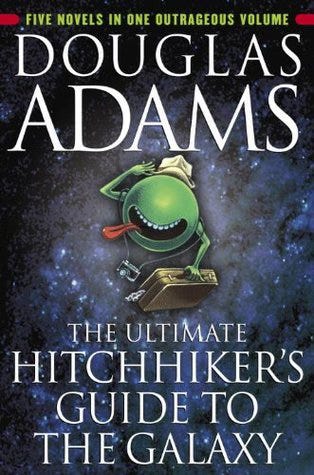
Hitchhiker’s Guide…, in case you don’t know, is about a hapless Englishman, Arthur Dent, who has discovered that his house is going to be destroyed to make room for a bypass. He lies down in front of a bulldozer to stop it. At that moment, though, his friend, Ford Prefect, arrives to insist that they leave the Earth, which, as Arthur soon discovers, is being destroyed to make room for a hyperspace bypass. So begins a series of bizarre and often rather philosophical adventures, involving a deeply intelligent and deeply depressed android, a race of psychopathic poem-writing aliens, a computer that offers the answer to “the Ultimate Question of Life, the Universe, and Everything” but doesn’t say what the question is, and much, much more.
Adams’s humour is a lot more sharp than his towel-bearing admirers might lead you to think. The best jokes surprise you while also making sense, rather than just surprising you while being completely inexplicable. “There is an art, it says, or rather, a knack to flying,” begins a throwaway line of Life, the Universe and Everything, “The knack lies in learning how to throw yourself at the ground and miss.”
Adams’s humour could also be dark and poignant rather than just quirky. I’m thinking of “Share and Enjoy” — the slogan of the gratingly cheerful complaints department of the Sirius Cybernetics Corporation, which sells a robot called “your plastic pal who’s fun to be with” but ultimately says that if it malfunctions you can “stick your head in a pig”.
I’m thinking of the whale who materialises in the sky and has a jolly rush of thoughts before its sudden death. It has just decided on the word “ground” to describe the “big and flat and round” thing it has been approaching when it asks, “I wonder if it will be friends with me?”
“And the rest, after a sudden wet thud, was silence.”
Indeed, Adams had a keen sense for human feeling. In the first book of the novelised version of The Hitchhiker’s Guide…, Arthur Dent reflects on the destruction of Earth:
England no longer existed. He’d got that—somehow he’d got it. He tried again. America, he thought, has gone. He couldn’t grasp it. He decided to start smaller again. New York has gone. No reaction. He’d never seriously believed it existed anyway. The dollar, he thought, has sunk for ever. Slight tremor there. Every Bogart movie has been wiped, he said to himself, and that gave him a nasty knock. McDonald’s, he thought. There is no longer any such thing as a McDonald’s hamburger. He passed out. When he came round a second later he found he was sobbing for his mother.
Adams was a self-described “radical atheist”. His friend, Richard Dawkins, dedicated The God Delusion to him. His puddle joke — which compares advocates of the fine-tuning argument to a puddle marvelling at its fortune for inhabiting a hole that so precisely suits it — challenges my own agnostic wonderings about the strangeness of existence. But Adams was no smug reductionist. The Hitchhiker’s Guide is full of unanswered existential pondering. Adams was also a man who proved his love of the richness and variety of life on Earth with his environmental activism, described in his book Last Chance to See.
The man couldn’t write female characters to save his life (which I believe he acknowledged). The later books and series of The Hitchhiker’s Guide were not half as strong as the earlier work. I’m not a big fan of any of the filmed adaptations, in which the quirkiness drowns out the philosophical and satirical content. (On a minor, narrowly political note, while I share Adams’s frustration with cold bureaucracies, nowadays the state is liable to thwart rather than impose construction.)
But 25 years after Adams’s death, his work deserves to be remembered — not for the cultural epiphenomena but for the sharp and humane comedy. The bizarre elements of The Hitchhiker’s Guide… were not bizarre for the sake of it but bizarre in a manner that jokingly illuminated real-life questions — existential mysteries, moral dilemmas, cold bureaucracies, and, yes, English manners. (With reference to the tweet I mentioned earlier, the toxic nature of oikophobes should not stop you from laughing at yourself.)
So, revisit The Hitchhiker’s Guide to the Galaxy. Introduce your kids to it. Just don’t watch the film.
THHGTTG was the first book I purchased with my own money as a young teen. While I have a much more mixed reaction than you about the movie treatments—after all, think about what a tremendous challenge it must have been to render a vision that quirky and eccentric as an accessible film—I did find them lacking in many respects. Far too much of the philosophically offbeat and outlandish dialogue was excised in the interests of getting the running time into Hollywood range (a prime example of this is the opening scene where Arthur blocks his home's demolition with his own body and the resulting dialogue with Mr. Prosser):
''But Mr Dent, the plans have been available in the local planning office for the last nine months.''
''Oh yes, well as soon as I heard I went straight round to see them, yesterday afternoon. You hadn't exactly gone out of your way to call attention to them had you? I mean like actually telling anybody or anything.''
''But the plans were on display ...''
''On display? I eventually had to go down to the cellar to find them.''
''That's the display department.''
''With a torch.''
''Ah, well the lights had probably gone.''
''So had the stairs.''
''But look, you found the notice didn't you?''
''Yes,'' said Arthur, ''yes I did. It was on display in the bottom of a locked filing cabinet stuck in a disused lavatory with a sign on the door saying 'Beware of the Leopard.'''
Thanks for the remembrance of what was a highly influential book from my youth. Now that I think of it, I should probably try to get those recordings of the BBC series for car trips, too.
I rewatched the movie recently, and it was much better than I had remembered. I’m re-reading the “trilogy in five parts” right now, and while I’m enjoying it (and loving the philosophical comedy), it is striking me hard that while some *scenes* are good, and some jokes are great, the structure of the thing isn’t very good. Adams is best at the line-and-page level. Much less so at the chapter and book levels.