

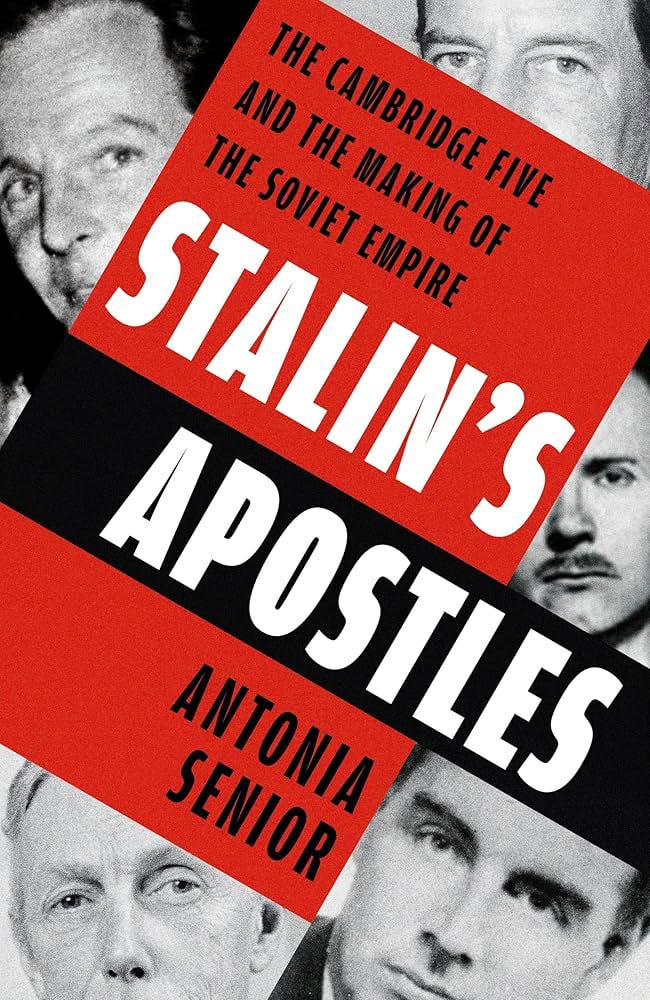
Antonia Senior’s book Stalin’s Apostles explores the history of the Cambridge Five — highly educated, well-connected British men — Kim Philby, Guy Burgess, Donald Maclean, Anthony Blunt and John Cairncross — who were spying on behalf of the Soviets.
My conclusion? They were bad guys. Really, really bad guys.
I know — this is the sort of radical judgement that only the most courageous opinion commentator would express. Who would have guessed that communist spies were bad?
But not everyone has thought that the Cambridge Five were bad — or, at least, that they were especially bad. Alan Bennett, who wrote two — very good! — plays about the men, has said:
I liked the notion of the Cambridge spies betraying their class; I liked them two-timing it … Spying is excusable because they thought that they were doing something to improve things, that they were morally on the right side. None of the spies spied for money. They all did it out of conviction …
With all due respect to a writer I admire, this seems like bunkum. Jihadists and Nazis also do things “out of conviction”. Am I meant to believe that Jihadi John and Lord Haw Haw were thinking, “I want to make things worse! Worse, I say!” The point is that they have cruel and irrational convictions.
Whatever one thinks about the Cambridge spies “betraying their class”, meanwhile — and I’m against it — they were also betraying helpless partisans who were sent into the jaws of Stalin, and desperate Central and Eastern European patriots who were struggling behind the scenes to build diplomatic support for their homelands. The likes of Kim Philby and Guy Burgess could enjoy the comforts of the nation they were undermining — warm offices, pink gin and sexual impropriety — while sending young men who had nothing to their doom.
One of Senior’s conclusions in this fascinating, elegantly written book is that the Cambridge Five really did believe in what they were doing. They were committed communists and not mere opportunists or — as Anthony Blunt would later have had people believe — misguided anti-fascists. Burgess “had a dream of the Soviet state”. Philby “had complete faith”.
But I think at least some of the Cambridge Five were driven by something more individualistic — a desire for excitement and significance. “I was being offered a very interesting future,” Philby would reflect on his recruitment, “A very interesting life.” Say what you like about them but they certainly had interesting lives.
At a more insightful moment, Bennett suggested that some of the Cambridge Five had suffered from “an overdose of Englishness”, and I think there’s something to the idea that Philby, Burgess and Maclean, at least, were reacting to the shabbiness and anxieties of inter-war England by projecting the imperial instinct onto the exotic Soviets. Senior comments on the “sense of Anglocentric exceptionalism” that convinced them that if world revolution was going to happen, Britain “would be best served by being in its rightful place as the vanguard”.
As disgraceful as they were, the Cambridge Five were striking personalities. I’m not quite sure how people lie prolifically and consistently. I couldn’t do it. I would have spilled the beans before they had even been served. I suppose lying becomes natural — aided by the sort of compartmentalisation that enables less ambitious men to juggle families. I suppose the booze, which the spies drank prodigiously, must have quelled doubts — though it makes it even harder to believe that none of the rotters gave themselves away.
Having prolific spies at the heart of the establishment was hugely embarrassing for Britain, of course. (Though the U.S. also had Harry Dexter White and Nathan Gregory Silvermaster. McCarthyism did not arrive in a vacuum.) But the “chapocracy”, as Senior entertainingly describes the clubbish and complacent class of establishmentarians that enabled the Cambridge Five, was already doomed. The easy faith in Britishness that had coasted on material and cultural success was evaporating in an age of rival superpowers, technological progress, calamitous war and — relatedly if somewhat separately — philosophical deconstruction. The idea that “England expects” was struggling to survive in an age where so much less was expected of England.
In An Englishman Abroad, Bennett portrays Guy Burgess’s drink-sodden, England-obsessed exile in Moscow — quoting poetry and pining for his London tailors. My own emigration was entirely innocent, and I’m glad and fortunate to be in Poland, but I would be lying if I claimed to see no resemblance to how I read the Telegraph and check the cricket scores. Identity can be a complex and evolving phenomenon in a world without old certainties.
Building it on lies, though — lies told to others and lies told to ourselves — makes it not just insecure but in constant danger of collapsing — exposed, however impressive it might once have looked, as a shabby fraud.
Completely agree about Bennett being too soft on these dreadful traitors. It’s funny that Philby wanted an ‘interesting life’ and ended up in his Moscow flat living like a hikikomori.
Highly recommend you read Tim Powers’ Declare—a highly original historical fantasy in which Kim Philby is the main antagonist