

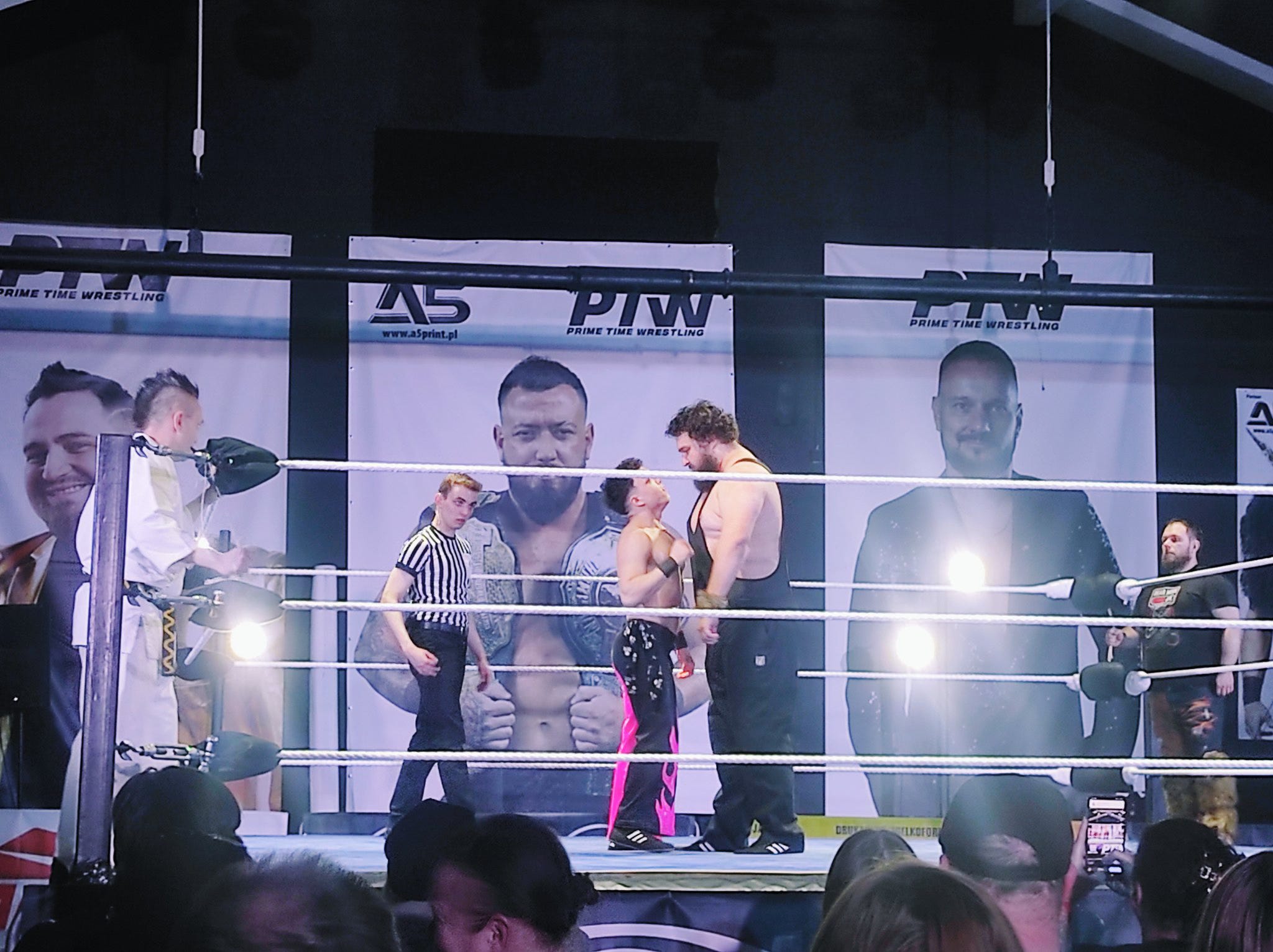
In Las Vegas, at the Allegiant Stadium, tens of thousands of World Wrestling Entertainment fans are preparing to watch Cody Rhodes take on Randy Orton at the annual Wrestlemania event. In an obscure village outside Gliwice, Poland, meanwhile, a couple of hundred Prime Time Wrestling fans are preparing to watch Spartan take on Vincent Caravaggio in a little building at the side of a restaurant.
I take a seat on a bench that swings wildly upwards if too much weight is applied to either end. Excited children, hairy men in WWE shirts and grizzled babcie, among others, are eating slices of pizza or drinking bottled beer. A bespectacled announcer steps nervously into the ring. The event has an endearing ramshackle feel.
Five minutes later, I am howling in outrage as the British veteran Johnny Storm is robbed of victory. It might as well be Las Vegas after all.
Polish pro wrestling does not have the millions of fans, and billions of dollars, of American pro wrestling but the audience makes up for it with enthusiasm. Heroic “babyfaces” are greeted with rhapsodic cheers. Villainous “heels” are showered with boos. The fans know all the wrestlers and their catchphrases. Even the girl auctioning signed shirts appears to be beloved.
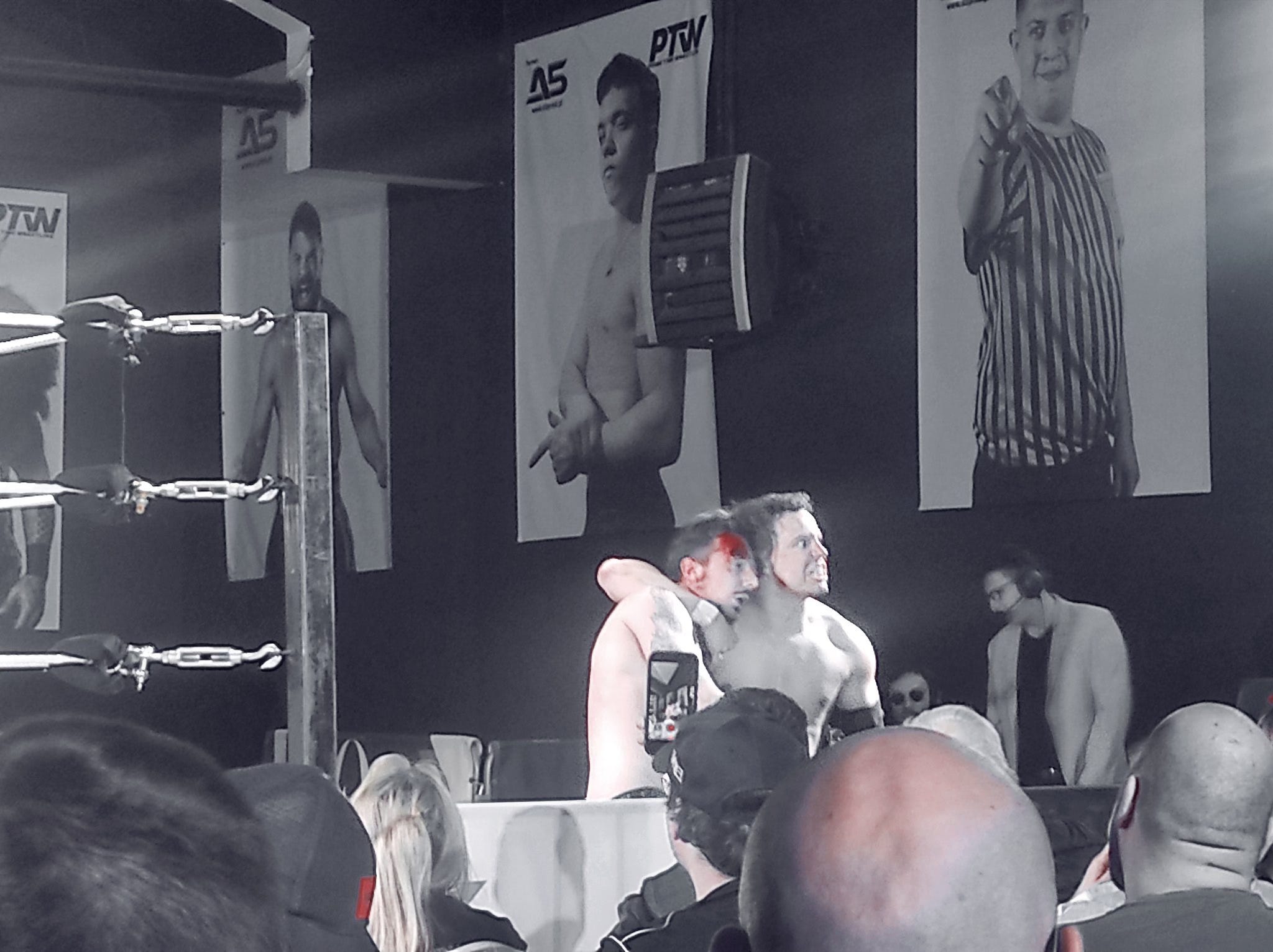
Professional wrestling does not have the believability that it once did, in an age before mass media exposed the tricks of trade. Watching live, though, you can suspend your disbelief. As the egomaniacal Nano Lopez hammers a chair into the back of the plucky local boy Daniel Razor, while blood dribbles down Razor’s face, the audience snarls with indignation. So do I.
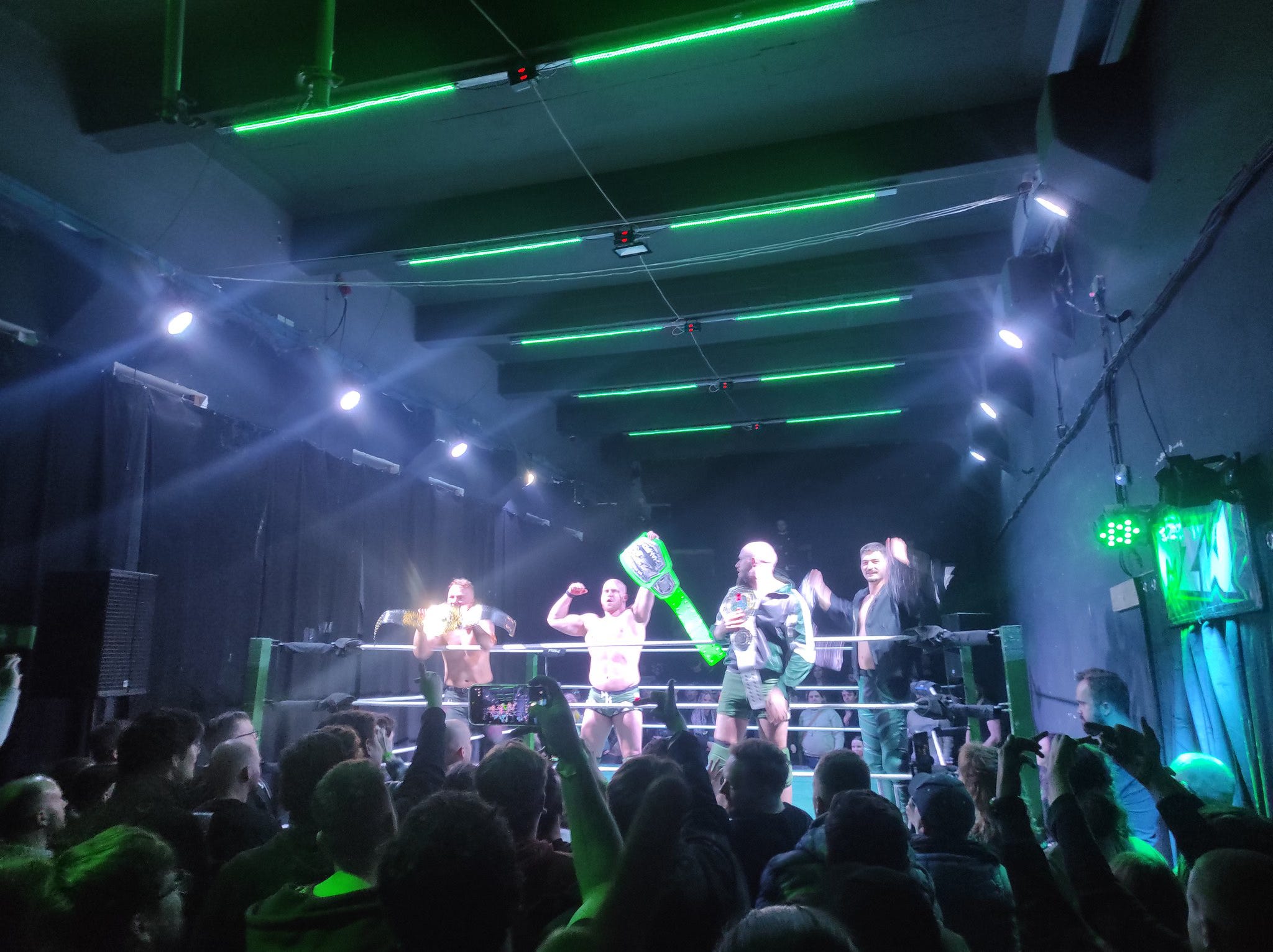
A few weeks earlier, in Wrocław, I had stood in a dark room in the bowels of a cavernous nightclub, as rabid fans of Maniac Pro Wrestling exhorted the host of the event to show his ass. He tore off his jacket to reveal a shirt that bore a pair of cartoon buttocks. The crowd erupted.
With an increasingly prosperous Poland creeping towards membership of the G20 — a scenario that would have seemed fantastically implausible two decades ago — people have more money for entertainment. Much of this entertainment, predictably, has been inspired by American cultural products. From reality TV to horror films, Polish pop culture has adopted tropes from U.S. media. Polish professional wrestling is no exception. There are similar archetypes, similar storylines and even some of the same slogans (“Leeeeet’s get ready to ruuuuumble!”).
Professional wrestling was not born in the United States, but Americans have spread it around the world. The unprecedented success of World Wrestling Entertainment led to market dominance in the US. Its ultimate global reach sent spores of inspiration across the planet.
WWE has toured everywhere from Europe to India. Next year, controversially, Wrestlemania will take place in Riyadh, which marks the next step in the economically fruitful if morally dubious relationship between the organisation and the Saudis. Now, independent wrestling promotions have emerged everywhere from Poland to Uganda, where Soft Ground Wrestling has become something of an internet sensation thanks to wrestlers hurling each other across the mud. American admirers crowdfunded to get SGW a ring.
A triumph of Americanisation? To some extent. But look closer and local particularities emerge. At Maniac Zone Wrestling, the most hated wrestlers are a pair of shaven headed heels who have adopted the persona of football hooligans. It is not their thuggishness that makes them truly hated, though — it is the fact that they represent Legia Warszawa. At Prime Time Wrestling, the mysterious masked wrestler Whiteblade reveals his true heinousness by choking a wrestler with a scarf that bears the colours of the Polish flag. One of my favourite acts of the night was a tag team called the Forest Brothers — a pair of hulking ursine men you can imagine roaming the Bieszczady Mountains in search of prey.
There is, sometimes, no clear distinction between the universal and the specific. At its best, culture can take global inspiration while being locally rooted. This is true in the world of poems and novels and it is true in the world of armdrags and powerbombs. Economists call this “glocalization”, and as much as it can be as superficial as McDonald’s serving teriyaki burgers in Japan, it can also mean infusing that which has universal appeal — like, say, theatrical displays of violence — with the colours of one’s home.
Polish professional wrestling (“Po wrestling”?) might be a niche subculture but it seethes with ambition. Prime Time Wrestling, which was formed in 2021, has hosted international stars like Santino Marella, Matt Sydal and, most impressively, Mercedes Moné, a former champion in World Wrestling Entertainment and its rival All Elite Wrestling.
Polish pro wrestling is heavily decentralised, with various promotions across the country. This has led to real-world disputes, with PTW, for example, facing an exodus of talent in 2024 amid financial and creative disagreements. On the bright side, this leads to brand loyalty that bigger and richer promotions would love to have. In Wrocław, dedicated “Maniacy” viciously insult wrestlers from rival companies. (Hardcore fans are also touchingly solicitous towards viewers, like me, for whom it is their first MZW show.) As I approach the Prime Time Wrestling event, meanwhile, the fields around the village of Kozłow echo with chants of “PTW!”
There is no shortage of genuine talent in the Polish scene. At MZW, Jakub, who once performed in PTW as Axel Fox, is bursting with charisma — a heel with as hateable a smirk as you will ever see. At PTW, Spartan is the epitome of a conquering champion — a giant man with an aura of invincibility. Bart Petro is a babyface who reminds me of an old era of British wrestling — a working class hero with a body you can imagine being formed by manual labour rather than steroids and bicep curls.
True, some of the wrestling can be sloppy. True, some of the doormen look more fearsome than most of the guys in the ring. But the passion and dedication are inspiring. These wrestlers are not making serious money. The chance of making serious money is minimal. But they very obviously love what they do, and their training, and their dreaming, and their willingness to risk their health to entertain the audience is undeniable. From the lighting, to the music, to the t-shirts, an insane amount of effort has also been committed to the production, including by people who get none of the viewers’ acclaim.
Who knows. There have been successful Polish pro wrestlers. As far back as the 1970s, Ivan Putski, “The Polish Hammer”, was intimidating American audiences. Polish promoters can also take inspiration from the improbable success of Scotland’s Insane Championship Wrestling, which went from being a dream in a Glasgow flat to putting on stadium shows, working with WWE, and helping to launch the careers of global stars like Grado, Joe Hendry and, especially, former WWE champion Drew McIntyre.
These are rare success stories in an industry where promotions live more precarious lives than BASE jumpers. Still, culture, and business, are all about taking risks. The Polish economy has risen on the back of entrepreneurial dynamism — on the sort of ambition, as well as hard work, that commits people, for example, to thinking that an idea for parcel lockers might inspire a company, InPost, that has transformed logistics across Europe. Polish culture needs that sort of bold commitment to making the unlikely real, and it shines through the men and women who swagger out of their locker rooms as if they are in stadiums and not in pubs, clubs and restaurants. Here, they are stars however many people know it.
Of course, in entertainment being successful is not just about making a profit. It is about making people happy. In Wrocław, the MZW show ends in triumph for a villainous heel group, but the Maniacy are soon cheerfully discussing the event over cigarettes. In Kozłow, as the crowd heads out towards the fields, in a haze of blood-sated satisfaction, I hear one family talking in English with American accents. I don’t think they were disappointed to have missed Wrestlemania.